
In editorial circles, a quiet shift has been unfolding. The home, long the supporting cast in fashion imagery, has been promoted. Where the dress once stood alone, framed by a neutral seamless or a sun-faded Roman wall, the interior now competes for attention — its furniture, its lighting, its objects all part of the same composed mood. Nowhere is this collapse between fashion and interiors more visible than in lighting, and one silhouette in particular has captured stylists, set designers and creative directors alike: the mushroom lamp.
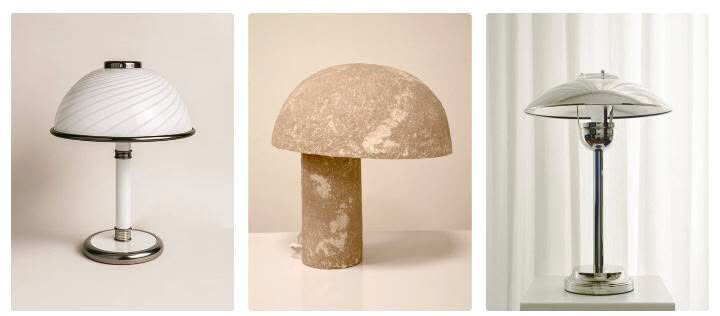
There is something about the form that resists irony. The dome, the rounded stem, the slight asymmetry of a hand-finished shade — these proportions carry a softness that minimalist pendants and engineered tube lighting cannot offer. The mushroom lamp is sensual without being precious. It belongs to the same lineage as a Phoebe Philo trench or an Issey Miyake pleat: confident in form, generous in atmosphere. For anyone curating their interior with the care normally reserved for a wardrobe, the designer mush lamps curated by The Oblist offer a starting point that is both architectural and quietly theatrical.
A material story worth telling
The current wave of mushroom lighting is not a literal mid-century revival. The most interesting pieces leaving studios today reinterpret the silhouette through unfamiliar materials. Take the work of Jorge Suárez-Kilzi, a Venezuelan-born architect and artist working between Spain and the wider Mediterranean. Trained in Japan and Switzerland, Kilzi brings a deeply considered material vocabulary to his “Mush” series: fibreglass blended with organic resins, finished with a surface that recalls papyrus and traditional Japanese washi paper. When lit, the lamp glows from within — translucent rather than illuminated, more lantern than fixture.
The collection comes in two principal forms: the “Giant” floor lamp, sculptural enough to anchor a corner the way a Noguchi might, and the “Big Head” table-top model, scaled for a console or a bedside. Each piece is hand-finished and made to order, which means no two share the same imperfections in surface or tonal warmth. For collectors, this matters. For the fashion-trained eye, it is the equivalent of bespoke versus prêt-à-porter.
Styling for the mood, not the trend
Trend-led interiors age quickly — the same way fast-fashion accessories date by the season. The mushroom lamp avoids this trap because its shape is rooted in something older than the trend cycle: the universal silhouette of natural form. Style it on a travertine console alongside a single ceramic vase, and it reads as serene minimalism. Place it on a marquetry bedside next to a stack of vintage art books, and it leans warm, lived-in, almost cinematic. In a Notting Hill flat with high ceilings, it punctuates the room without dominating it. In a smaller space, it becomes the single object you arrange the room around — much as one might build an outfit around a single, perfect coat.
Editorial photography has caught on. Recent shoots in AD, Cabana and T Magazine have begun staging fashion editorials inside fully composed interiors, and the mushroom silhouette appears with increasing frequency — often softly lit, often slightly out of focus, always in conversation with the figure in front of it.
The convergence
There has long been an artificial line drawn between fashion and interiors, with the assumption that one is worn and the other inhabited. The current generation of designers and collectors is dissolving that line. A handmade lamp, a sculptural chair, a textured rug: these are increasingly considered with the same scrutiny a fashion editor applies to a hemline or a fabric weight. Material, provenance, the story of the maker — all of it matters.
For those building an interior with this sensibility — slow, considered, more gallery than showroom — it is worth knowing where to look. The Oblist have positioned themselves at this intersection, working with independent designers and ateliers across Europe whose pieces sit comfortably alongside a couture wardrobe. The mushroom lamp is one entry point. There are many others.